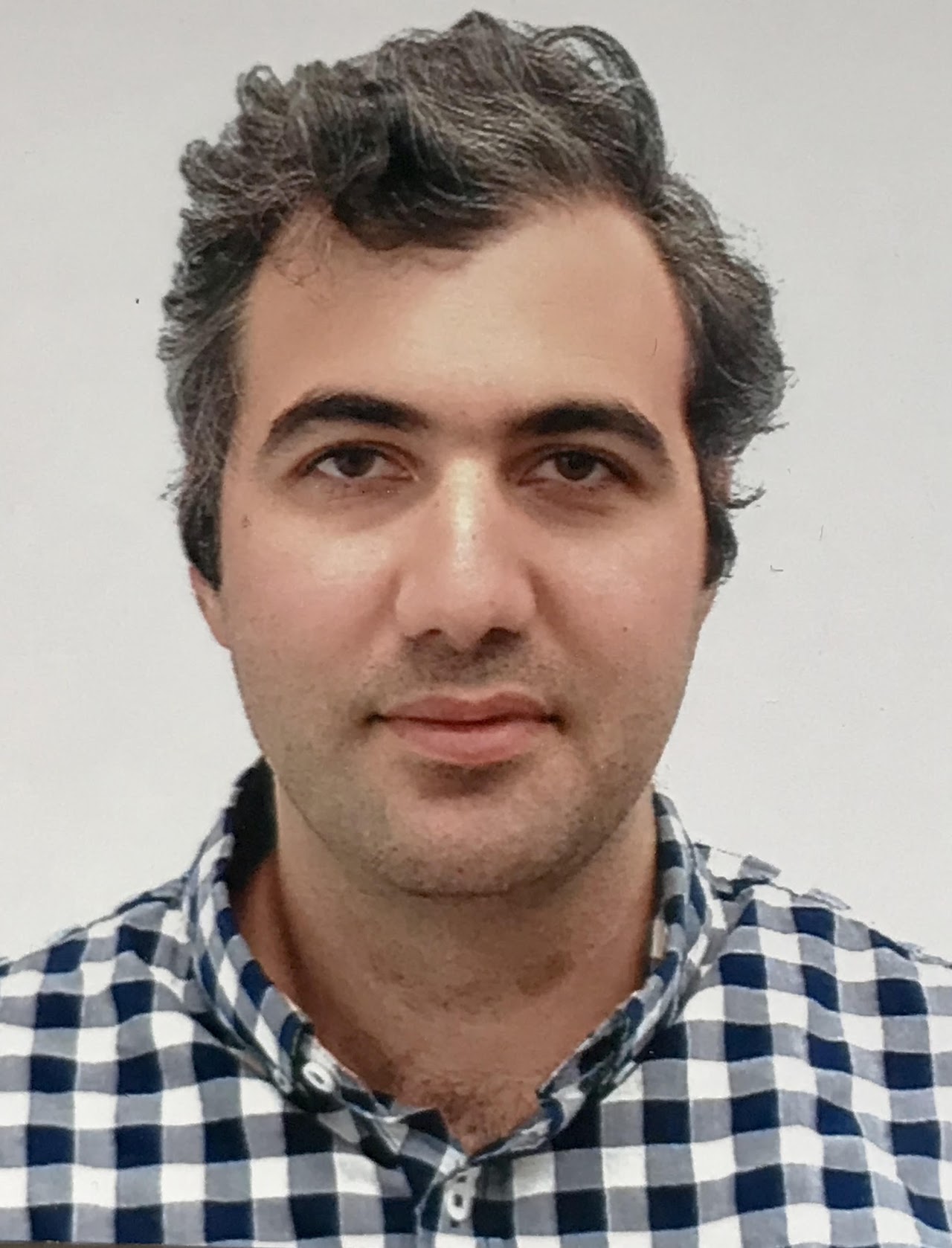
Efe Onaran
Hi! I am a postdoctoral researcher in the Department of Electrical and Systems Engineering at the University of Pennsylvania. From 2024 to 2026, I was also a visiting scholar in the Department of Mathematics, where I taught courses in 2024 and 2025.
Previously, I was a postdoctoral research associate at the Coordinated Science Laboratory of the University of Illinois Urbana–Champaign, hosted by Yuliy Baryshnikov, and a postdoctoral fellow at the Technion, hosted by Omer Bobrowski and Robert J. Adler.
My research interests broadly span probability theory and stochastic processes, random geometric graphs, and stochastic topology. Earlier, I worked on statistical and algorithmic limits for recovering structured signals, particularly permutation data.
Curriculum vitaeGoogle ScholarEmail
Education
- PhD in Electrical Engineering, New York University
- MS in Electrical Engineering, Princeton University
- BS in Electrical Engineering, Bilkent University
Papers
Journal articles and preprints
Ising disks: topology preserving Glauber dynamics. Yuliy Baryshnikov and Efe Onaran.
Journal of Applied and Computational Topology 10(3), Paper 16 (2026). journal · arXiv
Central limit theorems for local functionals of dynamic point processes. Efe Onaran, Omer Bobrowski, and Robert J. Adler.
Electronic Journal of Probability 31, 1–31 (2026). journal · arXiv
Functional central limit theorems for local statistics of spatial birth–death processes in the thermodynamic regime. Efe Onaran, Omer Bobrowski, and Robert J. Adler.
The Annals of Applied Probability 33(5), 3958–3986 (2023). journal · arXiv
Shuffled linear regression through graduated convex relaxation. Efe Onaran and Soledad Villar.
Preprint (2022). arXiv
Gbps user rates using mmWave relayed backhaul with high-gain antennas. Jinfeng Du, Efe Onaran, Dmitry Chizhik, Sivarama Venkatesan, and Reinaldo A. Valenzuela.
IEEE Journal on Selected Areas in Communications 35(6), 1363–1372 (2017). journal
Silicon–Germanium multi-quantum well photodetectors in the near infrared. Efe Onaran, M. Cengiz Onbasli, Alper Yesilyurt, Hyun Yong Yu, Ammar M. Nayfeh, and Ali K. Okyay.
Optics Express 20(7), 7608–7615 (2012). journal
Conference papers
Efficient belief propagation for graph matching. Efe Onaran and Soledad Villar. (2020).
IEEE International Conference on Acoustics, Speech and Signal Processing (ICASSP).
Projected power iteration for network alignment. Efe Onaran and Soledad Villar. (2017).
Wavelets and Sparsity XVII.
Optimal de-anonymization in random graphs with community structure. Efe Onaran, Siddharth Garg, and Elza Erkip. (2016).
50th Asilomar Conference on Signals, Systems and Computers.
Broadcast erasure channel with feedback: The two multicast case—algorithms and bounds. Efe Onaran, Marios Gatzianas, and Christina Fragouli. (2013).
International Symposium on Network Coding (NetCod).
Talks
- 2026
Rutgers University, Applied and Computational Math Seminar
- 2026
AFOSR Dynamical Systems and Control Theory Review
- 2024
Penn / Temple Probability Seminar
- 2024
Bernoulli–IMS 11th World Congress in Probability and Statistics, Bochum
- 2024
CRM–PIMS Summer School in Probability, Montréal
- 2024
Koç University Mathematics Seminar
- 2023
UIUC Probability Seminar
- 2022
Random Structures and Algorithms, Gniezno
- 2022
Queen Mary University of London Probability and Applications Seminar
- 2022
Technion Probability Seminar
- 2022
Purdue University Probability Seminar
Slides
Research
In the paper Ising disks: topology preserving Glauber dynamics, written with Yuliy Baryshnikov, we introduced a Glauber dynamics on a subset of contractible cubical complexes that we call clumps. See Pach's animals for a related definition. In the planar case, the state space is equivalent to the set of self-avoiding polygons.
Teaching
University of Pennsylvania
- Mathematics of Change, Part II (MATH 1080)Instructor · Fall 2025
- Advanced Applied Probability (MATH 5460)Co-instructor with Robin Pemantle · Spring 2025
- Mathematics of Change, Part II (MATH 1080)Co-instructor with Robin Pemantle · Fall 2024
University of Illinois Urbana–Champaign
- Optimum Control Systems (ECE 553, MATH 595)Instructor · Spring 2024 · Course information and syllabus
New York University
Head teaching assistant
- Applied StatisticsUndergraduate, Tandon School of Engineering Mathematics · Spring 2020
- Probability TheoryUndergraduate, Tandon School of Engineering Mathematics · Fall 2019
- Probability and Stochastic ProcessesGraduate, Tandon School of Engineering Electrical and Computer Engineering · Spring 2016
- Signal ProcessingUndergraduate, Tandon School of Engineering Electrical and Computer Engineering · Fall 2015
Grader
- Mathematical Tools for Data ScienceGraduate, Courant Institute and Center for Data Science · Fall 2019
- Inference and RepresentationGraduate, Courant Institute and Center for Data Science · Spring 2019
- Optimization and Computational Linear AlgebraGraduate, Courant Institute and Center for Data Science · Fall 2018
- Machine LearningGraduate, Tandon School of Engineering Electrical and Computer Engineering · Fall 2017
Tutoring
- High school mathematics for Regents ExamsTutor, Opportunity Charter School, New York · Summer 2019
Contact
Emaileonaran@seas.upenn.eduefeonaran@gmail.com
AffiliationUniversity of Pennsylvania
Philadelphia, PA